What Is Agentic Commerce? A Consumer-First Definition

Custyle Lab
Research & Guides · May 18, 2026·18 min read

TL;DR: Agentic commerce is when an AI agent shops, designs, or buys on your behalf — not when an enterprise vendor automates B2B procurement. The category's press coverage is dominated by IBM and Salesforce. The actual lived experience is happening at OpenAI, Amazon, Perplexity, and vertical platforms like Custyle.ai. This is the consumer-first definition.
Jump to: The Two-Sentence Definition · The Framing Gap · Three Camps · Market Size · The Stack · AI Merch Agents · Gen-Z Reality · Value Chain · Made-to-Order Fit · Trust · FAQ
A Two-Sentence Definition That Doesn't Sound Like Enterprise PR
Agentic commerce is the delegation of the complete shopper function — from intent interpretation through product discovery, design, transaction, and fulfillment — to an AI agent acting for an individual consumer. You set the taste, the budget, the constraints. The agent does the rest.
That's it. No mention of supply chains. No procurement workflows. No "AI-mediated B2B value chains." Most articles you'll read about agentic commerce in 2026 wrap the term in enterprise framing. That's because the loudest voices in the category — IBM, Salesforce, SAP — sell to enterprises. The actual experience millions of people now have, daily, looks nothing like that.
If you've asked ChatGPT to find you a hoodie. If you've let Amazon Rufus pull together a Halloween fit from a description. If you've described a vibe to Custyle.ai and watched it become a real shirt — you've already lived in agentic commerce. You just didn't call it that.
Agentic commerce, for consumers, is when you stop being the shopper and start being the person who has taste.
The Framing Gap: Why IBM's Definition Missed Consumers
Search "what is agentic commerce" in 2026 and you'll get IBM whitepapers, Salesforce blog posts, and SAP product pages. (IBM) The most-cited definition belongs to IBM: "AI agents [that] act on behalf of consumers or businesses to research, negotiate and complete purchases, often without direct human intervention." It's technically correct. It's also written by a company that sells procurement software.
This shapes what people believe agentic commerce is. When McKinsey publishes a $3 to $5 trillion forecast that bundles B2B procurement, logistics, and payment rails, (McKinsey via sanbi.ai) investors read it as an enterprise story. Regulators read it as an enterprise story. The press follows the budget.
Meanwhile, the actual consumer-side evolution is the bigger story. Amazon's Rufus drove nearly $12 billion in incremental sales in 2025. (ppc.land) OpenAI's Operator became the first mainstream agent to complete purchases without human intervention. (ppc.land) Stripe and OpenAI co-developed the Agentic Commerce Protocol so an AI can pay without ever touching a card number. (Major Matters) None of these stories share IBM's framing. Most aren't even told as "agentic commerce" stories — they're filed as separate OpenAI product launches or Amazon shopping features.
The gap matters for three reasons:
- Enterprise vendors have bigger marketing budgets and established analyst relationships. They get to define the term first.
- B2B use cases articulate cleanly. "AI reorders office supplies" is easier to explain than "AI helps you express your taste in physical goods."
- The consumer experience is fragmented. ChatGPT, Perplexity, Amazon, Google, and vertical apps each own a slice. No single product commands IBM-level press attention.
The result: most readers walk away thinking agentic commerce is something happening to procurement officers. It isn't. It's happening to you.
Three Camps Fighting Over "Agentic Commerce"
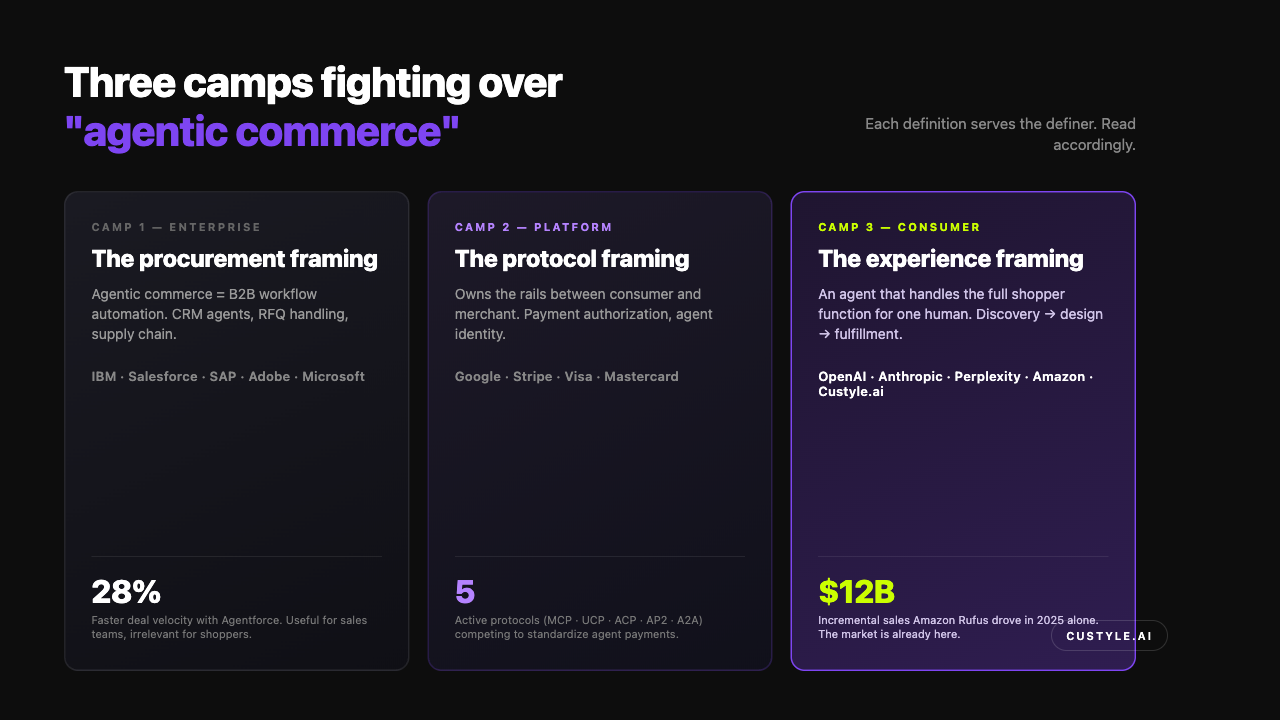
The definitional landscape splits into three groups. Each has a different stake in what the term comes to mean.
Enterprise vendors — the procurement framing
IBM, Salesforce, SAP, Adobe, Microsoft. Their version of agentic commerce is workflow automation for B2B buyers. Salesforce's Agentforce orchestrates CRM and quote-generation agents — useful for sales teams, irrelevant for individual shoppers. (Salesforce) Salesforce reports 28% faster deal velocity and 35% lower customer acquisition cost. (Winfomi) Real business value. None of it touches the consumer experience.
Platform and payment companies — the protocol framing
Google, Stripe, Visa, Mastercard. These companies sit between consumers and merchants and want to own the rails. Google's Universal Commerce Protocol defines agentic commerce as "where AI doesn't just suggest products, but actually helps complete the task of checking out." (Ekamoira) Stripe's Agentic Commerce Protocol — co-built with OpenAI — introduces Shared Payment Tokens that scope an agent's spending authority by seller, amount, and time. (Major Matters) Mastercard's Agent Pay verifies user intent rather than just agent identity. (Stellagent) These framings bridge enterprise and consumer.
Consumer AI labs and vertical startups — the experience framing
OpenAI, Anthropic, Perplexity, Amazon, and vertical players like Custyle.ai. This is where the actual consumer experience is being built. OpenAI Operator navigates websites for you. Perplexity's Buy with Pro lets you check out inside a chat. Custyle.ai accepts a vibe — a memory, a meme, an aesthetic — and turns it into a manufactured product without a designer in the loop.
Each camp benefits from defining the category. Enterprise vendors want regulators to think "B2B." Payment companies want every agent transaction to flow through their rails. Consumer labs want trust and adoption. Reading any "what is agentic commerce" article without knowing which camp wrote it is like reading "what is fast food" written by McDonald's.
The most radical agentic commerce experience is not an AI that buys faster. It's an AI that creates inventory after you describe what you want.
The Market Is $144B to $5T — Why That Range Matters
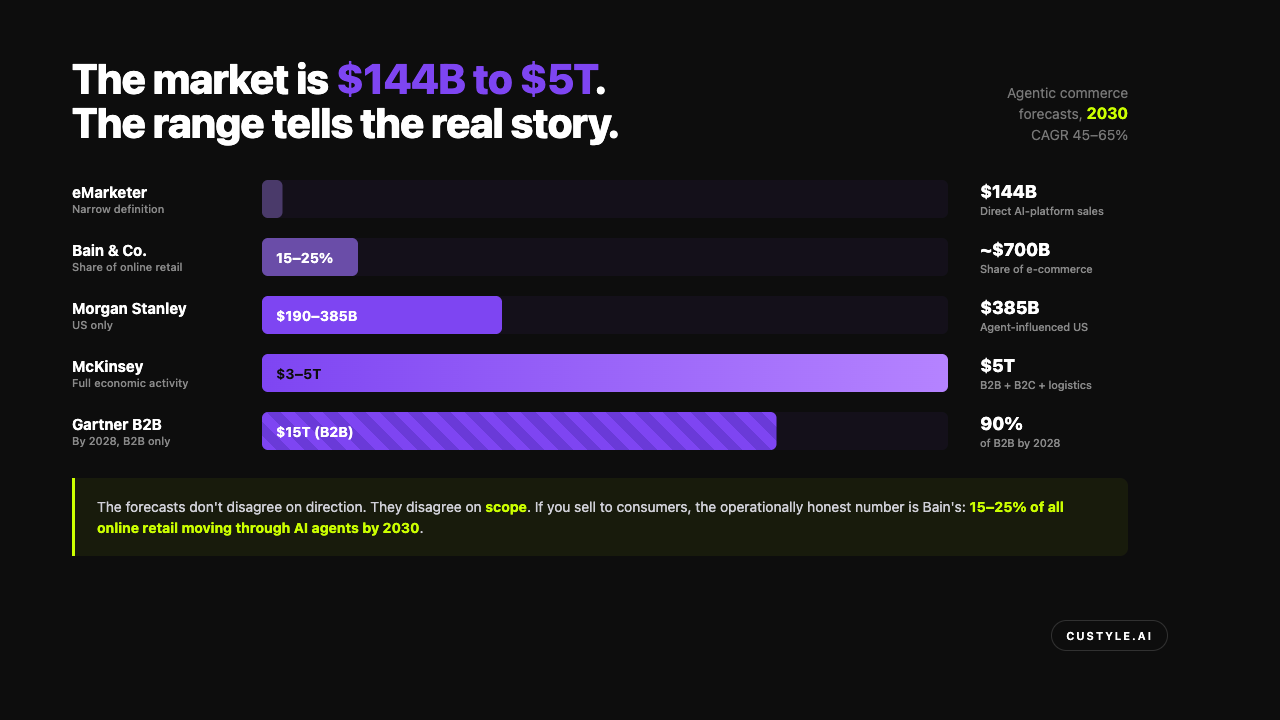
Forecasts for agentic commerce span a 35x range. eMarketer pegs the direct-sales-on-AI-platforms market at $144 billion by 2030. (eMarketer via Stellagent) McKinsey puts the full economic activity number at $3 to $5 trillion. (McKinsey via sanbi.ai) Morgan Stanley splits the difference at $190 to $385 billion of U.S. agent-influenced or agent-executed e-commerce. (Morgan Stanley via sanbi.ai)
The range isn't a disagreement about direction. Every analyst thinks agents are moving to the center of purchasing. The range reflects what each is measuring.
| Forecast | 2030 estimate | What it counts |
|---|---|---|
| McKinsey | $3–5T global | B2B + B2C + logistics + payments |
| Morgan Stanley | $190–385B (US) | Agent-influenced or executed e-commerce |
| Bain | 15–25% of e-commerce | Share of total online retail |
| eMarketer | $144B | Direct sales completed within AI platforms |
| Gartner (B2B) | $15T by 2028 | B2B spending through AI agents |
The number you care about depends on what you build. If you sell to enterprises, the McKinsey figure matters. If you're a consumer brand wondering how much shelf space agents will occupy, the Bain "15-25% of e-commerce" line is the operationally honest one. That's a quarter of online retail moving through AI agents within four years. The CAGR for the segment is 45-65% — versus 7-12% for traditional e-commerce. (sanbi.ai)
Gartner's most-quoted prediction: 90% of B2B purchases will flow through AI agents by 2028. (Gartner via sanbi.ai) The consumer number is harder to forecast, but it's already meaningful — 65% of all consumers have clicked from an AI tool directly to a retailer site in 2026. (MediaPost)
How a Consumer Agentic Commerce Stack Actually Works
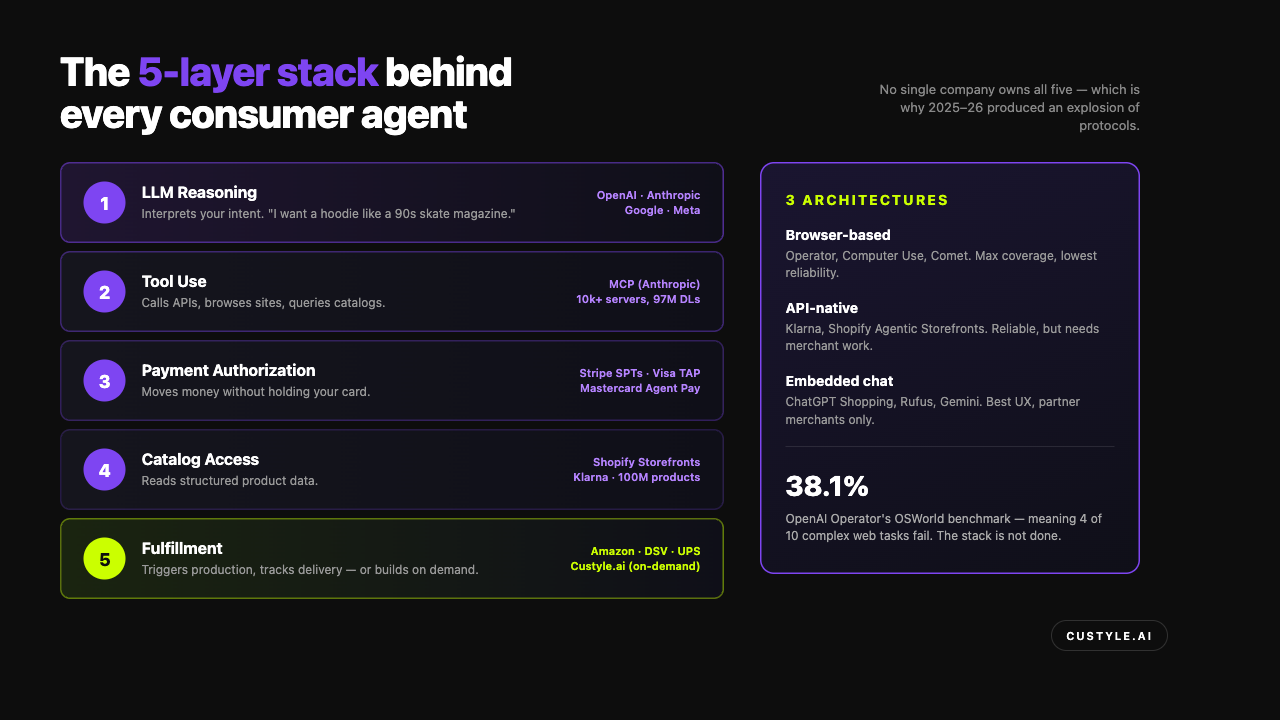
Every agentic commerce system runs on the same five layers. No single company owns all of them, which is why 2025-2026 produced an explosion of protocols and partnerships.
- LLM reasoning — interprets your intent. ChatGPT understands "I want a hoodie that feels like a 90s skate magazine." Claude does the same. The reasoning is the hardest part to make consistent.
- Tool use — the agent calls APIs, browses websites, or queries product catalogs. Anthropic's Model Context Protocol (MCP) is the universal interface — production-grade with 10,000+ public servers and 97M monthly SDK downloads. (Hexagon)
- Payment authorization — the agent moves money without ever holding your card. Stripe's Shared Payment Tokens are scoped, capped, and revocable. Visa's Trusted Agent Protocol signs identity into HTTP headers. Mastercard's Agent Pay verifies intent. (Major Matters) (Rising Wave)
- Product catalog access — the agent reads structured product data. Shopify's Agentic Storefronts syndicates merchants automatically to ChatGPT, Copilot, and Google AI Mode. (Shopify) Klarna's protocol exposes 100 million products across 12 markets. (Hexagon)
- Fulfillment integration — the agent triggers production and tracks delivery. For commodity goods, this means warehouse pick-and-pack. For made-to-order merch, the agent triggers manufacturing only after the order exists.
Three architectures dominate: browser-based agents (Operator, Computer Use, Comet — high coverage, low reliability), API-native agents (Klarna, Shopify Agentic Storefronts — reliable but require merchant integration), and embedded chat agents (ChatGPT Shopping, Rufus, Gemini — best UX, limited to partner merchants). OpenAI Operator scores 38.1% on the OSWorld benchmark — meaning it fails on roughly four of every ten complex web tasks. (Major Matters) The stack is not done.
Custyle.ai: What an AI Merch Agent Looks Like
Most agentic commerce platforms help you buy what already exists. Custyle.ai helps you make it real.
The category is the AI Merch Agent — a vertical agentic commerce stack focused on physical, made-to-order merchandise. Where Amazon Rufus searches Amazon's catalog and OpenAI Operator clicks through Etsy, Custyle starts somewhere different. You describe a vibe. The AI designs a product. A manufacturing partner produces it. The whole thing shows up at your door. No skills needed. No minimums. No generic-looking merch.
Why this takes nine agents instead of one: "turn a vibe into a real shirt" is not a single task. It's a creative pipeline that sparks at the moment you type:
- Vibbi captains the crew. She reads your intent and orchestrates everyone else.
- Pia picks up your taste — the references, the unspoken leanings.
- Nova turns loose prompts into stronger creative directions with more point of view.
- Ink builds the artwork so the design feels intentional.
- Bolt figures out the right way to build it — right process, right material, right finish.
- Grid, Axis, Moxy, and Lumi handle layout, product form, try-on, and scene.
That's the difference between "an AI that picks a t-shirt from a catalog" and "an AI that creates the t-shirt that didn't exist five minutes ago." → Read about the future of custom merchandise
An AI Merch Agent does not stock products. It creates them after the consumer expresses intent.
This is agentic commerce in its most radical form: no inventory, because the catalog is your imagination. From taste to tangible in the time it takes to describe it. Custyle's creator program offers up to 30% revenue share with zero inventory risk. That business model only works because the agentic layer collapses design, production, and fulfillment into one chat. → Learn about the creator program
Gen-Z Is Already Living in Agentic Commerce
The consumer adoption story isn't theoretical. It's already happened — for the right generation.
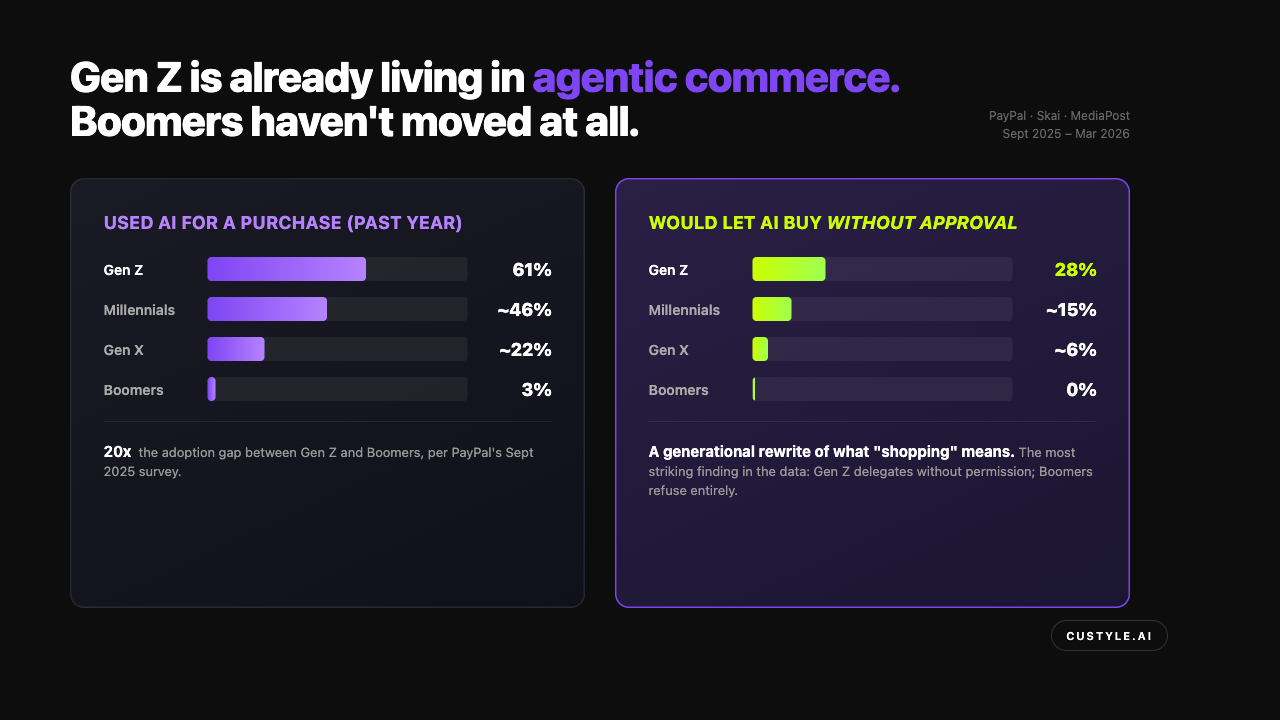
A September 2025 PayPal survey found 61% of Gen Z used an AI tool to help with a purchase in the past year. The figure for Boomers: 3%. (eMarketer) Skai's March 2026 survey of 1,000 U.S. consumers found 29% of Gen Z have made a purchase directly through ChatGPT's shopping feature. For Boomers, 5%. (MediaPost)
| Generation | Use AI for product research | Comfortable with AI making the final purchase |
|---|---|---|
| Gen Z | 33% prefer AI over search engines | 34% |
| Millennials | 26% | ~20% |
| Gen X | 13% | ~10% |
| Boomers | 3% | 0% |
The most striking finding is about delegation depth. 28% of Gen Z would let an AI buy without approval. Zero percent of Boomers will. (MediaPost) This is not a small difference. This is a generational rewrite of what "shopping" means.
What Gen Z buys through these agents skews toward identity-expressive categories — custom fashion, gifts made for one person, creator merch. Boring purchases (groceries, household supplies) show higher delegation readiness across all ages — 47% of consumers would let an agent handle repetitive shopping. (Ekamoira) Identity-expressive purchases start lower but pay back higher emotionally. The sweet spot for AI Merch Agents is the second bucket.
The Five-Stage Value Chain Reframe
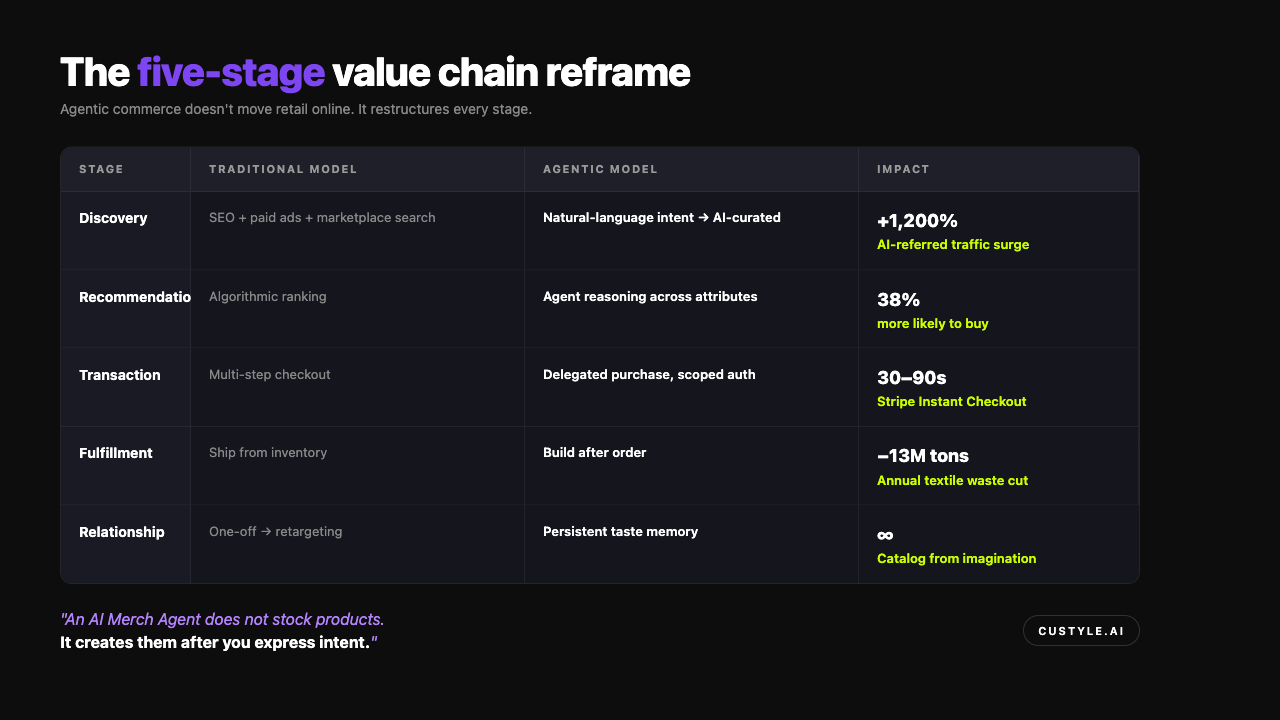
Agentic commerce doesn't just change how you shop. It restructures every stage of the value chain.
| Stage | Traditional | Agentic |
|---|---|---|
| Discovery | SEO + ads + marketplace search | Natural language intent → AI-curated selection |
| Recommendation | Algorithmic ranking | Agent reasoning across attributes |
| Transaction | Multi-step checkout | Delegated purchase, scoped authorization |
| Fulfillment | Ship from inventory | Build after order |
| Relationship | One-off → retargeting | Persistent taste memory |
Google search traffic to retail sites declined 10% in 2025-2026 while AI-referred traffic surged 1,200%. (OrganiKPI) AI-referred shoppers are 38% more likely to buy. (OrganiKPI) Stripe Instant Checkout compresses the purchase to 30-90 seconds. (Major Matters)
The most consequential shift is fulfillment. Traditional e-commerce ships from inventory. Agentic commerce — for the right categories — produces after the order. That eliminates the structural mismatch between mass-produced goods and individual taste. It also cuts ~13 million tons of annual textile waste from unsold inventory. (Custyle)
Why Made-to-Order Merch Fits Agentic Commerce Best
If you want to find where agentic commerce wins biggest, look at the categories that suffer most from the traditional model.
Traditional e-commerce is inventory bound. Warehouses full of products that may or may not sell. Forecasted catalogs that go on sale because demand was wrong. Made-to-order categories don't have this problem. When an AI Merch Agent creates a product after you describe what you want, the inventory mismatch disappears. The catalog becomes infinite — limited only by what you can describe.
Three structural advantages:
- Infinite catalog. Any design, any combination, any vibe. The shelf is your imagination.
- Made for one. Every piece is built for a specific person. No SKU forecasting.
- Creator economics. Anyone can earn from a design without owning inventory, manufacturing, or shipping. (Custyle Creators)
This is why the OpenAI-Stripe Instant Checkout partnership matters more for merch than for, say, electronics. You chat with an AI, decide on a custom-designed shirt, and buy it without leaving the chat. The AI handles design, production, fulfillment. Stripe handles payment. You handle having taste. → Read agentic creation vs agentic buying
The Trust Paradox (and How It Resolves)
The biggest barrier to agentic commerce isn't technology. It's trust. The trust story is more nuanced than the headlines suggest.
Only 14% of consumers trust AI recommendations on their own. 78% believe AI recommendations are influenced by advertisers. 60% don't trust chatbots with payment information. (Ivinco) These are rational responses, not Luddite ones. The market is opaque. Liability chains aren't settled. A bad autonomous purchase — a custom shirt you didn't want, a wrong-sized gift — costs real money.
And yet, Gen Z keeps using these tools. The reason is what analysts call the Trust Paradox: 49% of Gen Z say AI shopping "takes the fun out of the process," and 58% don't trust AI chatbots — but they use them anyway because the alternative (comparing thousands of options across dozens of sites) produces decision fatigue. (Ivinco) The average person faces ~35,000 decisions per day. AI agents aren't trusted advisors. They're cognitive relief valves.
Trust builds through experience. 94% of consumers who completed an AI-assisted purchase were satisfied. (Ivinco) Returns on AI-assisted purchases dropped 1.2% year-over-year per Adobe. The barrier is the first transaction. After that, trust compounds.
For platforms building consumer agentic commerce, the lesson is sharp: don't try to argue people into delegation. Make the first delegation experience so good that trust emerges from the outcome.
Where This Goes Next
Agentic commerce in 2026 is not one technology or one market. It's a spectrum — from AI-assisted product search at one end to fully autonomous creative-to-product pipelines at the other.
The enterprise vendors who dominate the category's press will keep dominating the press. They're building useful infrastructure. They're also the wrong people to learn the consumer experience from.
The consumer encounter will happen through products like Custyle.ai — a chat that turns your taste into a real piece of merch in minutes, with no skills required and no minimums. The whole value chain — discovery, design, production, transaction, fulfillment — compressed into a single conversation. Made for merch, built for you.
The enterprise vendors may own the category's press coverage. The consumer agents will own its future.
That's the consumer-first definition of agentic commerce. Not an AI that helps you shop faster. An AI that makes the distance between imagination and possession disappear.
FAQ
What is agentic commerce in simple terms?
Agentic commerce is shopping with an AI agent doing the work for you. You describe what you want; the agent searches, compares, designs, or buys. The category covers everything from ChatGPT Shopping helping you research a hoodie, to Amazon Rufus picking out a Halloween fit, to Custyle.ai creating a one-of-a-kind shirt from a vibe and shipping it to your door.
How is agentic commerce different from e-commerce?
E-commerce moved retail online but kept you doing the work — search, compare, click, checkout, repeat. Agentic commerce delegates those steps to an AI. You set the intent; the agent handles the rest. The two coexist for now. Bain forecasts AI agents will handle 15-25% of all online retail by 2030. (Bain via sanbi.ai)
Who coined the term agentic commerce?
Researcher Paul F. Accornero filed U.S. Copyright Registration TXu 2-507-027 for the concept in June 2025 and published the foundational paper The Shopper Schism on SSRN that September. (The AI Praxis) The term was adopted, redefined, and contested by IBM, Google, BCG, Salesforce, and McKinsey through early 2026 — each shaping the definition around their commercial interests.
Is agentic commerce safe?
Trust is the biggest barrier. Only 14% of consumers trust AI recommendations alone. Payment authorization standards are catching up fast. Stripe's Shared Payment Tokens are scoped to one seller, time-bounded, amount-capped, and revocable — a leaked token has bounded blast radius. (Major Matters) Mastercard's Agent Pay verifies intent rather than just identity. Most regulators haven't yet enacted specific rules; the EU AI Act will treat many agentic systems as high-risk starting August 2026. (GitHub Research)
What is an AI Merch Agent?
An AI Merch Agent is a vertical agentic commerce stack focused on physical, made-to-order merchandise — apparel, accessories, home goods. Custyle.ai is the prototypical example. You describe a vibe; the AI designs a product; a manufacturing partner produces it; the result shows up at your door. The category sits at the most radical end of the agentic commerce spectrum — the agent doesn't pick from a catalog. It creates the catalog after you describe it.
Sources cited inline:
- [^2] ppc.land — Amazon Rufus drove $12B in incremental sales (2025)
- [^5] Accornero, P.F., The Shopper Schism (SSRN, Sept 2025)
- [^9] IBM — What is agentic commerce? (ibm.com/think/topics/agentic-commerce)
- [^10] Salesforce — B2B Commerce innovations Spring 26
- [^12] Ekamoira — Google UCP announced at NRF 2026
- [^13] Major Matters — Stripe Agentic Commerce Suite review
- [^15] McKinsey via sanbi.ai — agentic commerce market $3-5T forecast
- [^16] Morgan Stanley via sanbi.ai — US agentic commerce $190-385B
- [^17] Bain & Company via sanbi.ai — 15-25% of e-commerce by 2030
- [^18] Stellagent — eMarketer $144B narrow forecast
- [^20] sanbi.ai — 45-65% CAGR vs 7-12% traditional e-commerce
- [^21] sanbi.ai — Gartner: 90% of B2B purchases via AI agents by 2028
- [^24] winfomi.com — Salesforce Agentforce B2B ROI
- [^25] ppc.land — Amazon Rufus $12B + 60% higher conversion
- [^26] Major Matters — OpenAI Operator OSWorld 38.1% benchmark
- [^31] Hexagon — Klarna Agentic Product Protocol, 100M products, 12 markets
- [^32] Shopify — How Agentic Commerce Works (Agentic Storefronts)
- [^33] emarketer.com — PayPal: 61% Gen Z used AI for purchase (Sept 2025)
- [^34] MediaPost — Skai survey: 29% Gen Z purchased via ChatGPT
- [^35] MediaPost — 65% of consumers clicked AI-to-retailer
- [^36] MediaPost — 28% Gen Z would let AI buy without approval
- [^49] Ivinco — Gen Z Trust Paradox (49% "takes fun out", 58% don't trust)
- [^51] Ivinco — 94% AI-assisted purchase satisfaction, Adobe returns data
- [^52] Ekamoira — Checkout.com 47% delegation for repetitive purchases
- [^54] OrganiKPI — Google search traffic -10%, AI traffic +1,200%
- [^55] OrganiKPI — AI-referred shoppers 38% more likely to buy
- [^56] Major Matters — Stripe Instant Checkout 30-90 seconds
- [^57] Custyle.ai — 13M tons textile waste annually
- [^60] Custyle.ai — Creator program 30% revenue share
- [^66] Ivinco — 14% trust AI, 78% suspect ads, 60% don't trust chatbot payments
- [^67] Major Matters — Stripe Shared Payment Tokens
- [^68] Stellagent — Mastercard Agent Pay tokenizes intent
- [^69] risingwave.com — Visa Trusted Agent Protocol
- [^73] Github — EU AI Act high-risk classification, Aug 2026
Full source bibliography in research.md.
Ready to make something?
Turn your ideas into real merch with AI. No design skills needed.
Start with a vibeCustyle Lab
Research & Guides · May 18, 2026·18 min read
Further Reading
Explore all →
Inside Pia: The Preference Reader of the Custyle Crew
Pia is the Preference Reader of the Custyle Crew — the second of nine AI agents. She turns vague taste into a clean signal every downstream agent can use.
Read more →
Meet the Custyle Crew: 9 AI Agents That Make Your Idea Real
Custyle isn't one AI — it's a crew of nine, each owning a stage of turning your vibe into real merch. Meet Vibbi, Pia, Nova, and the rest.
Read more →
AI Custom Products: The Complete Guide to Creating Anything from Text
AI custom products turn text descriptions into real physical goods. Complete guide covering the $69B market, three competing models, technology stack, and what's next.
Read more →
Prompt to Product: How AI Turns Words into Real Things
Prompt to Product is the capability to turn a text description into a real, purchasable physical product. You describe it, AI builds it.
Read more →