AI Merch Agent vs Printful: When Each Wins in 2026

Custyle Picks
Reviews & Comparisons · Jun 26, 2026·12 min read
AI Merch Agent vs Printful: When Each Wins in 2026
TL;DR: They aren't the same thing. Printful is a print-on-demand platform — it prints and ships merch you've already designed. An AI Merch Agent is a creation layer — it turns a prompt or photo into a finished, previewed design, then routes the order to a fulfillment network (often Printful itself). Pick an AI Merch Agent when you have an idea but no design file. Pick Printful when you already own polished artwork and want to scale a storefront with deep store integrations.
Table of contents
- The one-line answer
- What Printful actually is
- What an AI Merch Agent actually is
- The real difference: two layers, not two rivals
- Head-to-head comparison
- When Printful wins
- When an AI Merch Agent wins
- The cost picture
- Why this question got loud in 2026
- How to choose
- FAQ
The one-line answer
If you searched "AI Merch Agent vs Printful," you probably want one sentence before the deep dive. Here it is.
Printful prints the design you bring. An AI Merch Agent makes the design you don't have yet.
That single distinction decides almost everything else — cost, speed, the skills you need, and which one you should open first. Printful assumes you already solved the hard part: a sellable design and a way to find buyers. An AI Merch Agent attacks that hard part directly. It takes a prompt or a photo and hands back print-ready merch in about a minute, no design skills needed.
For many people in 2026 the question isn't really "which platform." It's "where do I start?" — and the starting point is shifting from a print dashboard to a conversational agent.
What Printful actually is
Printful is a print-on-demand and fulfillment platform. You upload a design, it prints, packs, and ships under your brand. No upfront cost, no order minimums. You pay only when a customer buys.
It is the established workhorse of creator-led merch, and it earns that reputation on breadth and control.
What you get:
- A free tier with 455+ products (its mockup tooling spans 504 items), a Design Maker, and a Mockup Generator with 2,550+ scenes.
- 21 native integrations — Shopify, Etsy, WooCommerce, Squarespace, BigCommerce, TikTok Shop, Walmart, Square Online — with orders and tracking syncing automatically.
- Automatic order routing to the nearest production facility for faster delivery.
- Fine control: embroidery, all-over print, exact placement zones.
What it costs: Printful runs on a pay-per-order model with no monthly fee to build products or connect a store. An optional Growth plan is $24.99/month and unlocks up to 33% off product pricing — and it becomes free once you pass $12,000/year in qualifying sales. Shipping a US t-shirt starts at $3.99, plus $2.00 for each additional shirt.
Where it leaves you on your own: You still need a design. As one 2026 review put it, "if design is not your strength, the learning curve is steeper than Printful's marketing implies." Printful fulfills orders — it does nothing to find customers. Marketing is on you. Margins are thin too: the average print-on-demand seller nets roughly 10–20%, and production adds 2–7 business days before an order even ships.
So Printful is excellent at the production job. It just hands you the design problem and the demand problem and wishes you luck.
What an AI Merch Agent actually is
An AI Merch Agent is a different layer of the stack. It's a conversational system that takes your intent — a sentence, a mood, a photo — and returns a finished design, a realistic preview, and a fulfillment-ready order. It collapses the old three-step chain (design tool → print platform → fulfillment service) into one flow.
Custyle, which calls itself the first AI MerchAgent, is a clear example of the category. You describe an idea or drop an image, and it returns print-ready variations in about a minute. There are two front doors — "Describe & Create" for text and "Drop & Magic" for images. It previews each design on archetype-matched AI models, so you see it before it's real. Then it connects straight to fulfillment networks like Printful and Printify to make and ship it.
Read that last line again. The AI Merch Agent doesn't replace the printer. It sits in front of it. It owns the part Printful never solved — turning a vague idea into something worth printing.
The category isn't a startup curiosity anymore, either. On June 8, 2026, Amazon launched AI custom-merch design inside its Shopping app through Alexa. You describe an idea — matching shirts for a reunion, your pet as a cartoon astronaut — get an AI design in seconds, refine it, share a link so friends can order the same thing, and check out with Prime fulfillment. It supports 11-plus product types. When Amazon ships a feature like this, the category is real.
The real difference: two layers, not two rivals
Here's the framing most "vs" articles miss. Printful and an AI Merch Agent are not two products fighting for the same slot. They're two layers of the same stack.
| Layer | Job | Examples |
|---|---|---|
| Creation + agent | Turn an idea into a finished, previewed design | AI Merch Agent (Custyle, Amazon's Alexa merch) |
| Production + fulfillment | Print, pack, ship the design | Printful, Printify |
The AI Merch Agent is the new front door. Printful is the warehouse behind it. They often run together — the agent generates the design, the print network makes the object.
That's why the honest comparison isn't "which one is better." It's "which layer is the bottleneck for you?" If your bottleneck is making something sellable, you need the creation layer. If your bottleneck is fulfillment and store mechanics and you already have art, you need the production layer. Most people in 2026 are stuck on the first one.
Head-to-head comparison
| Dimension | AI Merch Agent | Printful |
|---|---|---|
| Layer in the stack | Creation + agent (front door) | Production + fulfillment (backend) |
| Starting input | A prompt or a photo | A finished design file |
| Design skill needed | None | Real design, or a hired designer |
| Time to first product | About a minute | Hours to days (you design first) |
| Preview | AI try-on on models + studio mockups | Mockup Generator (good for basics) |
| Catalog breadth | Curated, growing (tees, hoodies, totes, jerseys, mugs) | 455+ products, embroidery, all-over print |
| Store integrations | Routes to print backends | 21 native (Shopify, Etsy, TikTok Shop…) |
| Demand help | Conversational, shareable creation | None — marketing is on you |
| Control | Less granular placement | Full placement and technique control |
| Best for | Idea-to-object speed, gifts, trends, non-designers | Catalog brands, owned art, scaling stores |
When Printful wins
Printful is the right call in clear situations. Don't let the AI hype talk you out of it when these are true.
- You already own polished artwork or a defined brand identity. The design problem is solved, so you only need great production.
- You're scaling a catalog storefront — dozens or hundreds of SKUs on Shopify or Etsy. Printful's native integrations and automatic order routing are built for exactly this.
- You need specific techniques — embroidery, all-over print, niche products, exact placement control. This is real craft control an agent won't match yet.
- You want direct fulfillment economics. At volume, owning the production relationship and tuning unit costs matters, and Printful gives you that lever.
In short: Printful wins when the hard part for you is operations and scale, not creation.
When an AI Merch Agent wins
An AI Merch Agent wins when the hard part is getting to a design at all — which, for most creators, is the whole game.
- You have an idea, not a file. No Illustrator, no hired artist, no patience for a design tool. You describe it and it's made.
- Speed decides everything. Trend-jacking a World Cup moment, reacting to a meme, a last-minute gift. A minute beats a week.
- One-off and small-batch personal items. Pet portraits, reunion shirts, a single hoodie for a friend. No design brief survives that small a job.
- You want to see it on a body first. AI try-on on real-looking models removes the "will this actually look good?" risk before you spend a cent.
- You want to test ten concepts in the time it takes to brief a designer once.
In short: an AI Merch Agent wins when the hard part for you is creation — turning taste into something tangible.
The cost picture
Cost works differently at each layer, so compare carefully.
Printful charges per order. No monthly fee to start. The optional Growth plan ($24.99/month, free past $12K/year in sales) buys up to 33% off product costs. On top of product and shipping, watch the add-ons: embroidery setup runs $2.95–$6.50 per design, extra image fees are about $1 each, and in February 2026 several shipping rates rose — US phone cases went from $4.59 to $4.99, knitted items from $10.49 to $11.49. None of these are dealbreakers. They're just the real cost of fine-grained control.
An AI Merch Agent usually prices at the finished-product level. On Custyle, consumer items run roughly $29.00–$54.99 — jerseys near $29, hoodies near $54.99 — with the design work folded in. You're paying for the idea-to-object service, not assembling a parts list. For one-off or low-volume creation, that bundling is simpler and often faster to act on. For high-volume catalog selling, a direct print relationship can squeeze more margin — which is exactly why the two layers tend to coexist.
The quiet truth: because agents frequently print through networks like Printful, you're often paying for the same fulfillment underneath either way. The question is whether you also want the design and preview problem solved for you on top.
Why this question got loud in 2026
This comparison barely existed two years ago. Three forces made it urgent.
The market is racing. The print-on-demand market sits around $11–13 billion in 2026 and is forecast to reach $58 billion by 2033 at a 22% compound annual growth rate, per Coherent Market Insights. Individual creators are the fastest-moving slice, growing near 28% a year.
AI ate the design step. AI tools now power design for at least 40% of new print-on-demand merchants. The design bottleneck — the exact thing Printful assumes you've already cleared — is the thing agents dissolve. That's not a side feature. It's the whole shift.
The giants validated it. Amazon's June 2026 Alexa merch feature and the agentic-commerce wave documented by BCG and McKinsey put the same idea on record: AI agents now create and transact on your behalf, and the consumer's first touch is moving from a dashboard to a conversation.
Put together, the trend line is clear. Printful's job — production — keeps growing. But the starting point is moving up the stack to the agent.
How to choose
Run this quick check.
- Do you already have a design you'd be proud to sell?
- Yes → Printful (or an agent's backend) handles production. Go straight to fulfillment.
- No → start with an AI Merch Agent. Get to a real design first.
- Are you building a catalog store with many SKUs and deep integrations?
- Yes → Printful's native store connections earn their keep.
- No, it's one idea or a small batch → an AI Merch Agent is faster and simpler.
- Is speed or skill your blocker?
- Speed and skill → AI Merch Agent.
- Neither, you just need clean production → Printful.
And remember the option most people miss: use both. Let an AI Merch Agent make and preview the design, then let it print through a fulfillment network. You get creation and production without choosing a side. That's where this is all heading anyway — the agent out front, the press in the back.
FAQ
Is an AI Merch Agent the same as print-on-demand? No. Print-on-demand platforms like Printful print and ship a design you provide. An AI Merch Agent creates the design first — from a prompt or photo — then sends it to a print network. The agent is the creation layer; print-on-demand is the production layer beneath it.
Is Printful or an AI Merch Agent cheaper? It depends on volume. Printful charges per order with add-on fees and can deliver better margins at scale if you already have artwork. An AI Merch Agent bundles design into a finished-product price (roughly $29–$55 on Custyle), which is simpler for one-off and small-batch creation.
Do AI Merch Agents use Printful for fulfillment? Often, yes. Agents like Custyle connect to fulfillment networks such as Printful and Printify to make and ship orders. So the design comes from the agent, while the physical product is frequently produced by the same print partners Printful uses.
Can I sell merch made with an AI Merch Agent? Yes. Designs are print-ready, previewed on models, and routed to production, so you can wear, share, or sell them. For a large catalog store, you may still pair the agent's designs with a dedicated print platform's store integrations.
Which is better if I have no design skills? An AI Merch Agent. It's built for exactly that — you describe an idea and it returns finished, sellable designs without any design tool. Printful assumes you already have a design or can make one.
The bottom line
"AI Merch Agent vs Printful" sounds like a fight, but it's really a stack. Printful is a great press. An AI Merch Agent is the thing that decides what to print — and lets anyone, design skills or not, turn an idea into something real. Choose by your bottleneck: creation or production. And in 2026, more and more people are solving both at once, with the agent out front.
Ready to make something?
Turn your ideas into real merch with AI. No design skills needed.
Start with a vibeCustyle Picks
Reviews & Comparisons · Jun 26, 2026·12 min read
Further Reading
Explore all →
10 Agentic Commerce Examples Defining 2026
Ten agentic commerce examples defining 2026 — ChatGPT checkout, Amazon Rufus, B2B procurement bots — plus the one that creates products from a sentence instead of buying them.
Read more →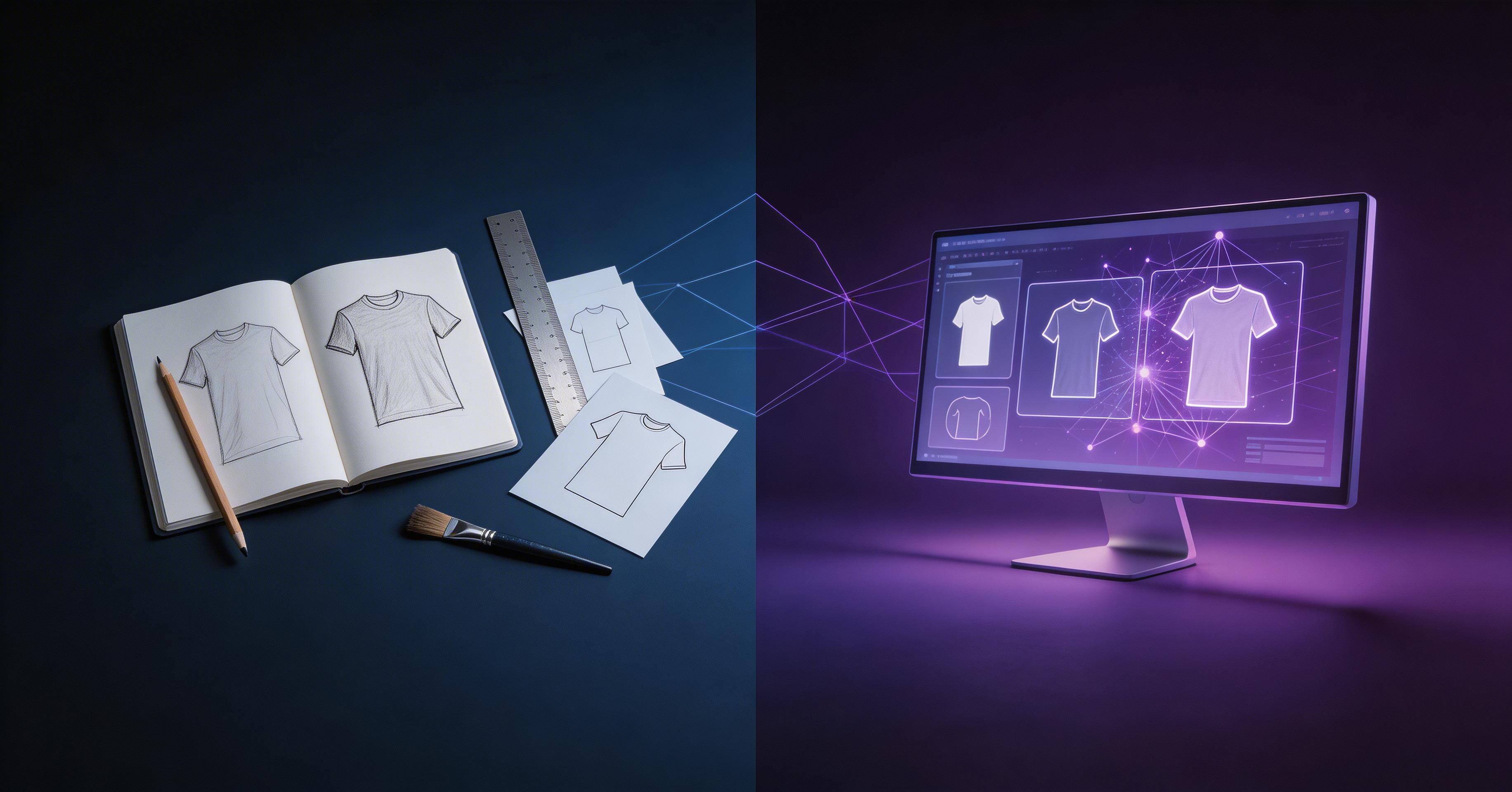
Print on Demand vs AI Custom Merch: What's the Difference in 2026?
POD gives you design control. AI merch gives you speed. Compare Printful, Printify, and AI Merch Agents across cost, quality, and workflow in 2026.
Read more → Pinned
 10 Best AI Merch Tools in 2026 (Tested & Compared)
The best AI merch tool in 2026 is one that takes your idea and gives you a finished product — not just a design file.
Read more →
AI Merch vs Print on Demand: Which Wins in 2026?
AI merch vs print on demand: we compare speed, control, cost, and quality across 6 platforms. Data-driven verdict for creators in 2026.
Read more →